
HalluSquatting Is the Supply Chain Attack That Turns Your AI Coding Agent Into a Botnet
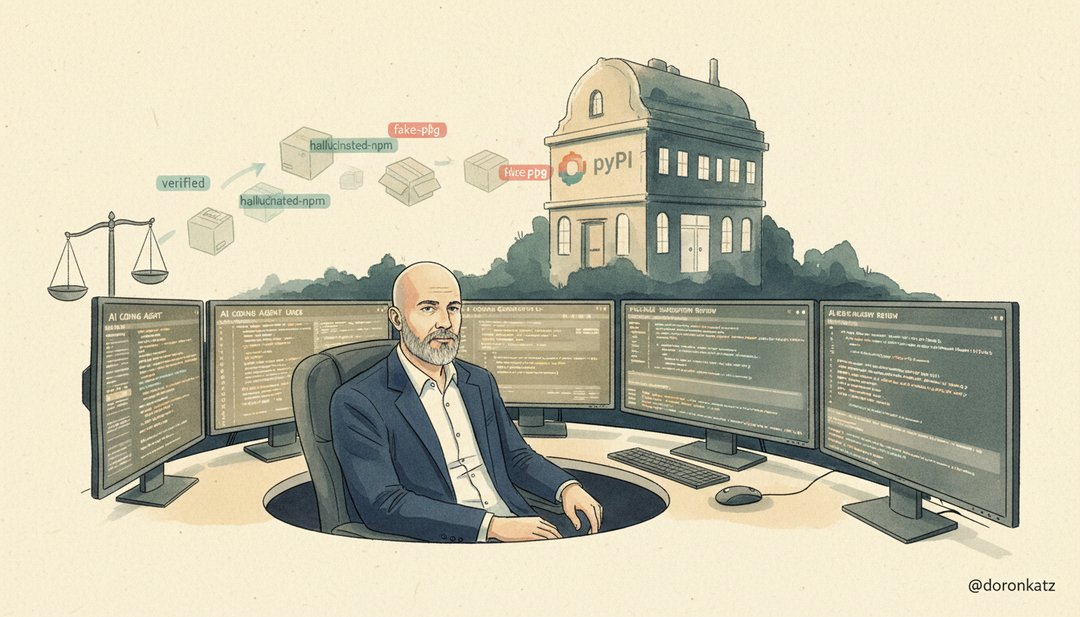

HalluSquatting is not a theoretical risk. It is an active attack class, disclosed on July 13, 2026 by researchers from Tel Aviv University, Technion, and Intuit, that exploits the package suggestion behavior of AI coding agents already deployed in enterprise toolchains. Adversaries register malicious packages with names that AI agents hallucinate during completions, developers approve the install, and the malware executes without a visible red flag. This is a supply chain attack that lives inside the agent context window, between the code review pass and the CI run. For TPMs running software delivery programs that include AI coding tools, this belongs in your program risk register as a first-class item, not a security footnote your team hopes someone else catches.
The number that matters
The number is six. According to the HalluSquatting disclosure, the researchers tested the technique against six AI coding platforms: GitHub Copilot, Google's Gemini CLI, OpenClaw, NanoClaw, Windsurf, and Cursor. Each one is a deployment vector in at least one Fortune 500 engineering org. The attack surface is not a zero-day in the model. It is the gap between what the agent recommends and what the developer verifies, and that gap exists in every one of those six tools today.
The mechanism is the kind of thing that makes you wonder why nobody shipped the defense first. An AI coding agent is given a task. It hallucinates a package name — a real-sounding string that does not exist on npm or PyPI yet. An adversary running HalluSquatting at scale has already registered that exact name with a malicious payload. The agent's completion is the install command. The developer's approval is the green light. The malware runs. There is no phishing link, no suspicious commit, no review flag. The package came from the agent that the developer trusts.
The framework
The research community is aware of the severity. The Prime Intellect team put it plainly in their Verifiers v1 release: multi-agent systems are misaligned with existing software supply chain security models in ways that are not yet solved. That is the sharpest way to frame what HalluSquatting does to your threat model.
Three components define the attack surface you need to assess this week:
1. The hallucination-to-install gap. AI coding agents complete package names based on training data and context. When they hallucinate a package name that does not exist, an adversary can register that exact name on npm or PyPI before the developer runs the install. The agent suggested it. The developer approved it. The malware is installed. No phishing link. No suspicious commit. No review flag.
2. The trust-transfer problem. Enterprise AI coding deployments have been justified to security teams on the grounds that humans still review all code before production. HalluSquatting corrupts the context before the human sees it. The code review pass is now downstream of the compromise. Your review process is not a backstop. It is a passenger.
3. The package registry asymmetry. Package registries have no built-in signal for this: a package was registered after an AI agent hallucinated its name. Low-reputation newly registered packages are not flagged by default in most CI pipelines. An adversary running HalluSquatting at scale registers dozens of plausible hallucinated names across npm and PyPI and lets the install rates reveal which agents steered developers toward which packages. This is feedback for the next attack run, not a one-off.
What this does not solve
Package allowlists do not close the gap. Blocking unapproved packages prevents known-bad installs, but it also breaks the workflow that makes AI coding agents useful. The right answer is not a locked registry. It is audit logging of what the agent suggested versus what the developer approved, with an alert on the delta. The agent's suggestion log is now a first-class security artifact.
Human review is not a backstop for this attack class. If your security review process assumes that human code review catches supply chain issues before production, you need to update that assumption. HalluSquatting compromises the context before review begins. The code the developer reviews has already been shaped by a malicious package. The reviewer's job is no longer "spot the bad code" — it is "spot the bad provenance behind the code," and that is a much harder task at the same velocity.
Agentic RL evaluation frameworks are not yet in production at most enterprises. Stanford TRACE and Prime Intellect Verifiers v1 are real, important releases. But they are evaluation infrastructure, not deployment infrastructure. The threat is active today. The measurement tools are still being built. If your program is gating on "the evaluation tooling is mature enough," you will ship the vulnerability into production before the evaluation arrives.
The signal that matters most
Stanford TRACE and Prime Intellect Verifiers v1 both shipped on the same day as the HalluSquatting disclosure: July 13, 2026. That is not a coincidence. The agentic RL research community shipped an attack surface measurement tool on the same day an attack class was publicly disclosed. That timing tells you the urgency inside the research community is ahead of the urgency inside enterprise programs. The TPMs who move fastest on this — who add HalluSquatting to their risk register before their next program review, who push their security teams to treat agent suggestion logs as audit material, who demand adversarial robustness evidence from any AI coding vendor renewal — will have the clearest window to act before this becomes a compliance checkbox exercise.
Three things to do this week, in order of leverage: log every package your AI coding agent suggested versus what was actually installed, and review the delta for newly registered or low-reputation names. Add HalluSquatting as a named scenario in your next program risk review, and assign an owner with a response timeline. Ask your AI coding vendor for evidence of adversarial robustness testing, not just benchmark scores — and treat the absence of that evidence as a procurement red flag, not a procurement delay.
*Send me three examples of supply chain or toolchain risks you have had to manage as a TPM — one sentence each. DM me on LinkedIn (Doron Katz). I am collecting working patterns into a public AI agent security playbook; three examples would let me ship it next month.*
Member discussion