
Coding Is Becoming Abundant — Merge Readiness Is the New TPM Control Surface
Thesis
The scarce resource in AI-assisted engineering is no longer code production; it is trustworthy promotion of code into a shared system. Qwen3.8-Max’s coding-and-cowork launch crossed 1,000 Hacker News points within hours of release on August 3, while a Claude Code founding engineer said on X that Claude writes more than 95% of his code—but explicitly distinguished that workflow from one-shot “vibe coding.” Lenny’s August 2 conversation with Whatnot CPO Tom Verrilli adds the organizational signal: fewer, more senior people doing real individual-contributor work can outperform ratio-driven product structures.
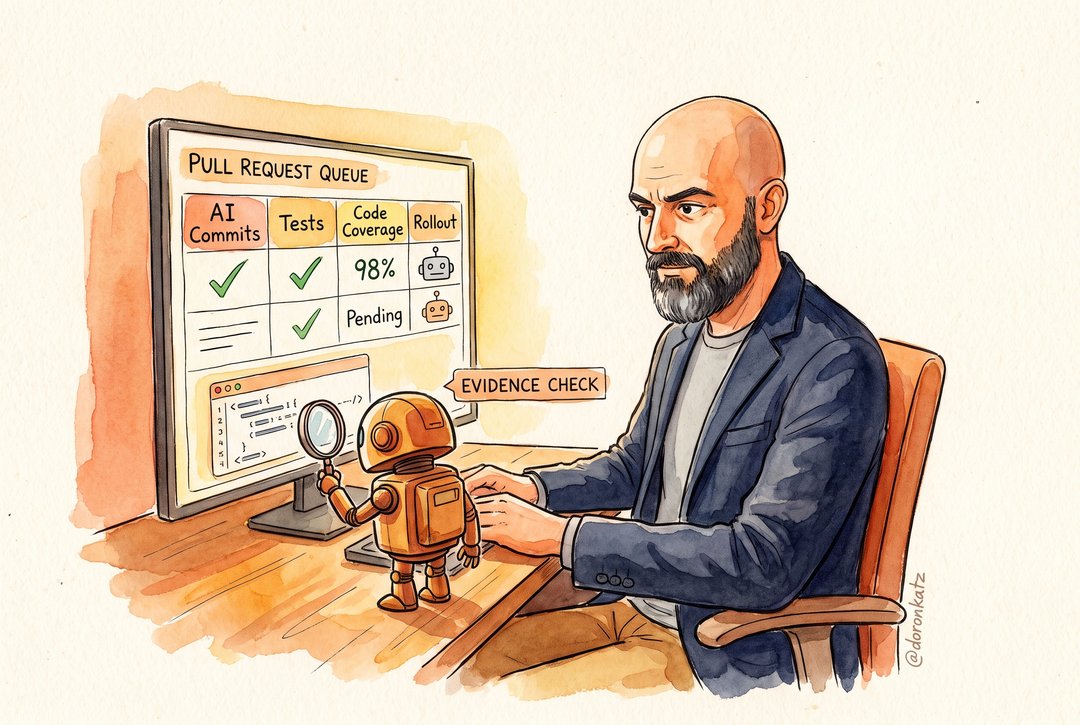
For TPMs, this changes the control surface. The job is not to celebrate faster ticket completion or add another status meeting. It is to make “ready to merge” and “ready to roll out” observable states with explicit scope, test evidence, reviewer ownership, rollback conditions, and production feedback. The claim is likely, not verified as a universal law: the sources are fresh practitioner and vendor signals, not a controlled productivity study.
Why Now
Three independent signals converged within roughly 48 hours: a major coding/cowork release attracted unusually strong practitioner attention; a frontier coding practitioner described near-total AI code authorship while preserving human architecture and planning; and a senior product leader argued for smaller, more senior teams doing the work directly. Together they point to a shift from implementation scarcity to judgment and verification scarcity.
The broader context is not entirely new. Bjorg Roche’s July 12 engineering-management analysis estimates that AI saves senior developers less time than juniors because design, architecture, code review, testing/deployment, and meetings remain substantial. That older signal is supporting context, not part of the seven-day convergence window. Hermes Agent v0.19.1 (July 30) and OpenAI Codex alpha releases (July 31) show the toolchain is still shipping rapidly, which increases the need for a stable promotion process.
The Signals Behind the Shift
- Qwen, “Qwen3.8-Max: A New Bar for Coding and Cowork,” August 3, 2026. The primary launch page is the source; its Hacker News discussion passed 1,028 points and grew past 500 comments within hours of the August 3 launch. That is a strong practitioner-attention signal that coding and cowork capability is becoming a platform expectation, not a niche experiment. The HN record is used for engagement evidence; the Qwen page is used for the product claim. Confidence: verified for publication and engagement; unverified for any vendor performance superiority claim. Qwen launch page · Hacker News discussion
- Sidharth Bidasaria (via @Yamik1shi repost), X, August 3, 2026. The X digest captured the Claude Code founding engineer’s claim that Claude writes more than 95% of his code, paired with an explicit qualification that this is not one-shot vibe coding: he plans with Claude, architects the system, and — per the X excerpt — 'defines the…' (the closing clause is reconstructed from the truncated digest excerpt; the full post was not independently transcribed). Confidence: likely—the digest provides the live signal and URL, but the post was not independently transcribed beyond the digest excerpt. https://x.com/i/status/2083622120261611844
- Lenny Rachitsky interview with Tom Verrilli, August 2, 2026. Whatnot’s CPO describes a product organization founded on the premise that it regrets product management as a ratio-driven function, favoring fewer, more senior people doing real IC work; the episode explicitly discusses how AI is reshaping the PM role. Confidence: verified for the published episode description; the full paid transcript was not used. Lenny: This CPO regrets that product management exists (Tom Verrilli)
- Bjorg Roche, “The AI productivity gap,” July 12, 2026. Roche’s engineering-manager model estimates that AI-assisted coding reduces a senior developer’s modeled day from 8 hours to 6.75, while design, architecture, code review, testing/deployment, and meetings remain materially intact. This is a transparent practitioner model, not a benchmark. Confidence: verified for what the article says; unverified as a general estimate. Bjorg Roche: The AI productivity gap
- Hermes Agent v0.19.1, published July 30, 2026, and OpenAI Codex rust-v0.147.0-alpha.4, published July 31, 2026. Both projects continued rapid release activity in the same window. Hermes described roughly 1,000 PRs merged since v0.19.0, while Codex published multiple alpha tags. These are ecosystem-velocity signals, not evidence that either tool improves engineering outcomes. Confidence: verified for release dates and repository metadata. Hermes Agent v0.19.1 release · OpenAI Codex rust-v0.147.0-alpha.4 release
TPM Angle
Reader: A TPM running an AI-assisted engineering program where coding agents or copilots can create pull requests, modify shared systems, or accelerate delivery beyond the team’s existing review capacity.
What to do differently:
- Define “ready to merge” as an evidence contract. Require scope, affected surfaces, automated test results, reviewer ownership, known limitations, and rollback notes before a change enters the merge queue.
- Split implementation throughput from promotion throughput. Track generated or opened changes separately from changes that pass review, deploy safely, and remain healthy after release.
- Add a human architecture checkpoint for agent-authored work. Make the reviewer confirm system boundaries, data-flow implications, dependency changes, and failure modes—not just code style or test passage.
- Set WIP limits on unreviewed agent output. Cap open agent-created pull requests, stale review queues, and concurrent rollout experiments so faster generation cannot silently create a larger quality bottleneck.
- Instrument post-merge evidence. Tie each promoted change to rollback rate, escaped defects, incident load, review latency, and user-impact signals; use the data to tune agent permissions and workflow design.
- Make rollout gates explicit in the program plan. Define canary exposure, stop conditions, owner-on-call, and rollback authority before the agent is allowed to widen the blast radius.
Why This Is Distinct
Recent briefs covered adjacent surfaces: the cognitive cost of multi-agent coordination (2026-07-29), deterministic policy enforcement for irreversible actions (2026-07-30), vendor control planes for agent products (2026-08-01), and WIP limits for AI-assisted workflows (2026-07-27). This brief is narrower: the promotion bottleneck after code has become cheap to generate — review capacity, merge evidence, and rollout, not policy enforcement or coordination tax.
Open Questions
- What is the right denominator for agentic engineering throughput? Opened pull requests, merged changes, healthy production changes, or user-validated outcomes each tell a different story.
- How much human architecture review is enough when the implementation is mostly machine-authored? The evidence supports preserving human judgment, but does not specify a review-time budget by risk class.
- When should an agent-created change be rejected even if tests pass? The sources point toward system reasoning and rollout evidence, but no shared acceptance standard has emerged.
- Will smaller senior teams actually improve outcomes, or only concentrate hidden review and operational load? Verrilli’s organizational claim is compelling but vendor- and company-specific; independent comparative evidence is still missing.
Member discussion