
AI Quality Gates Are Broken — And Agents Are Making the Problem Worse
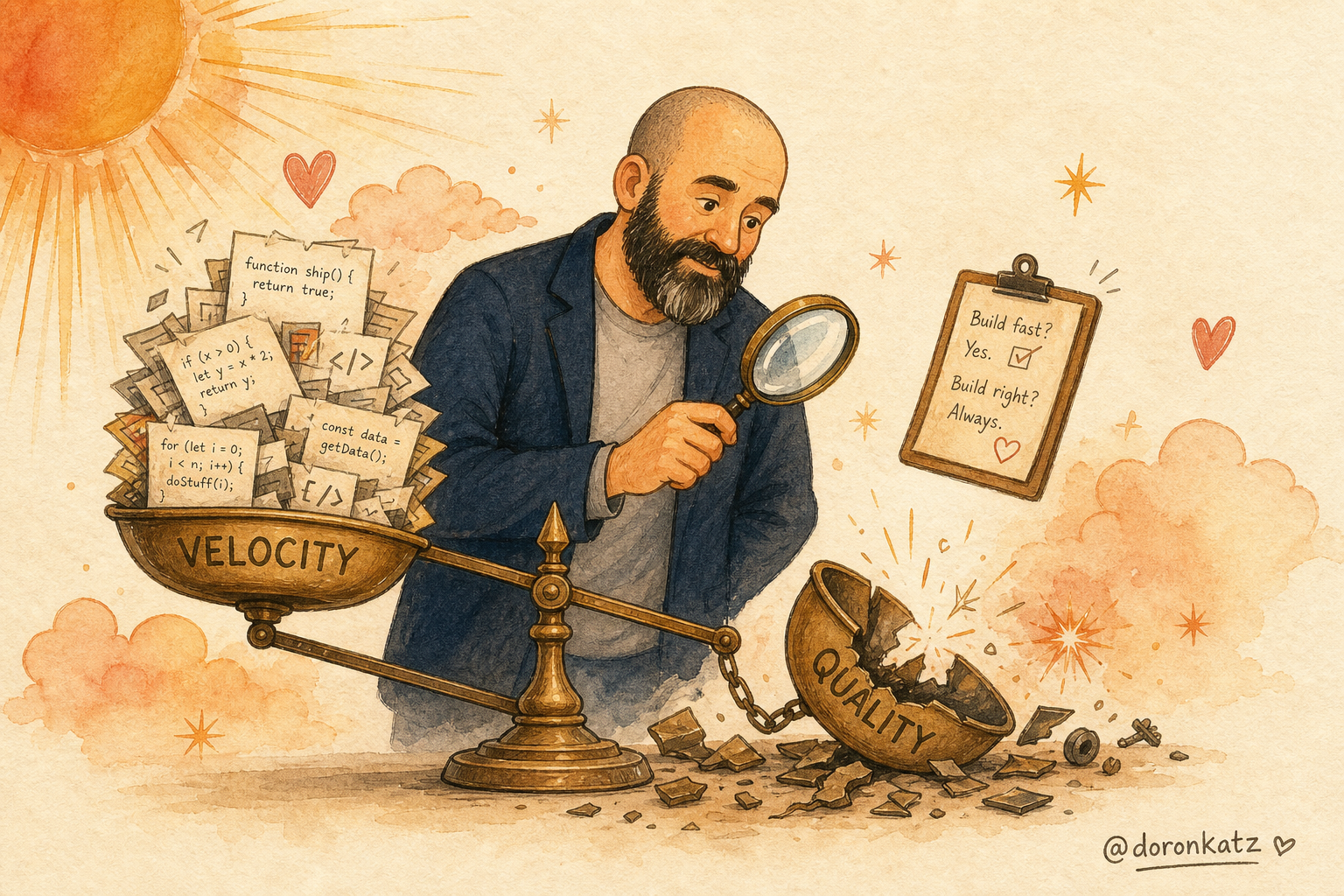
The CI pipeline says green. The linter says clean. The unit tests pass. The code is wrong.
If you are shipping AI-generated code in 2026, you have probably hit a version of this. The traditional quality gates — code review, static analysis, test coverage, dependency review — were designed for human authors who read the requirements, formed an intent, and translated that intent into code an evaluator could check. AI coding agents skip the intent step. They produce plausible code that satisfies the literal gate without satisfying the underlying requirement. The gate stays green. The product breaks anyway.
That is the AI quality gate problem, and it is now a production concern at every team I talk to. The signals in June 2026 made it impossible to ignore.
Three signals that converged in June 2026
Signal 1 — Martin Fowler named the security debt. Fowler's "VibeSec Reckoning" (martinfowler.com) is a careful, technical, non-alarmist read of the security and quality debt accumulating from vibe coding at scale. The "VibeSec" framing is the move: it elevates the problem from a developer productivity story to a governance crisis. When someone who built the patterns your enterprise runs on writes a piece called "VibeSec Reckoning," that is the moment to take the question to your security and compliance owners, not just your engineering managers.
Signal 2 — Microsoft documented a specific failure mode. The Microsoft Dev Blog post "Your agent just scaffolded a project from 2020" (devblogs.microsoft.com) is notable because it is a first-party admission. Microsoft ships GitHub Copilot and the Copilot CLI. When they publish a post documenting that their own agents default to outdated dependencies, deprecated APIs, and retired framework patterns because they lack temporal context, that is not a hypothetical. That is a measured, named, recurring failure mode happening in production with the tooling they sell.
Signal 3 — Google built knowledge infrastructure as a quality gate. Google Cloud's Open Knowledge Format (OKF), announced June 16 (marktechpost.com), is a vendor-neutral markdown spec for giving agents curated context. Read past the data-format framing. The real bet is: if you can specify what knowledge an agent must use, you can evaluate whether it deviated. That is a quality gate. It just lives at the knowledge layer, not the test layer.
The three signals share one shape. The quality bar that used to live in code review and CI is now too low for the speed and shape of AI-generated output. New gates are emerging, but they are uneven, vendor-specific, and not yet integrated into the standard CI/CD loop.
Why traditional gates fail with AI agents
Three structural reasons, not three tooling problems.
1. Gate latency vs. agent throughput. A human author commits a handful of changes per hour. A coding agent can produce a thousand lines per minute. The code review queue becomes the bottleneck, and the natural response is to "trust the agent and only review the diff" — which is exactly the path that turns the gate into a rubber stamp. The gate has not gotten worse at its job; the volume has overwhelmed its design point.
2. Plausibility is not correctness. A linter checks style. A unit test checks a function in isolation. A code review checks whether the code does what the reviewer thinks it should. AI agents are optimized to produce code that looks like code that solves the problem. They are not optimized to verify the code actually solves the problem under the actual conditions of your system. The agent that returns a confidence score of 0.91 is not telling you it is right 91% of the time. It is telling you the next token is statistically likely to follow. Your reviewer is not equipped to distinguish those two claims.
3. Temporal context is missing. This is the Microsoft finding. Agents do not have a built-in sense of "what is current" — they pattern-match across their training window. The Microsoft Dev Blog post gives a concrete shape to the problem: an agent scaffolding a new Next.js app reaches for next-auth v3 patterns and pages/-router conventions from before the App Router shipped, because those are the densest cluster in the training data. The result: code that passes the dependency review because next-auth is well-known, but uses an authentication pattern the team deprecated two years ago. Standard gates do not catch this because they check "is the dependency allowed," not "is the API version current."
What AI-native gates look like
If traditional gates are not enough, what replaces them? The market is converging on a few shapes:
Specification contracts as the input layer. A spec, written by a human, that defines what "done" means in a form the agent can be evaluated against. This is the spec-first movement; Microsoft Dev Blog's Spec-Driven Development post (June 10, 2026) is the canonical industry writeup. The spec is the gate, and the agent's output is checked against it. If the spec is missing, the agent's output is by definition unevaluable — and the work is by definition unreviewable.
Sensor-based evaluation at the output layer. Fowler's "maintainability sensors for coding agents" series describes automated evaluators that score AI-generated code against explicit criteria: regression coverage, dependency currency, architectural conformance, security posture. Sensors do not replace human review; they triage. They tell the human reviewer where to look, and they tell the engineering manager which commits to slow down on.
Knowledge grounding as the context layer. Google's OKF is the institutional version of "give the agent a curated context to draw from instead of relying on its training data." The pattern shows up in Microsoft Learn grounding, in Hermes skills that bind an agent to a specific knowledge base, and in the broader trend of treating context as infrastructure. The gate here is: did the agent use the right knowledge, and can you prove it?
Trace-first review at the behavior layer. For agents that act — calling tools, mutating state, sending messages — the question is not "is the code right" but "did the agent do the right thing in the right order." The approach is to make every agent action traceable at the contract layer: which capability was invoked, what inputs it received, what it returned, and whether the return matched the contract. A traceable contract layer (the pattern Hermes uses for its skills) is one way to do this; LangSmith traces, GitHub Copilot spec mode, and Microsoft Learn grounding are other implementations of the same idea. The gate is the trace, and the reviewer audits the trace, not the code.
The TPM angle
This is where the article earns its keep. TPMs are the natural owners of quality governance for AI-augmented teams. Three reasons:
- TPMs already own the cross-functional review process. Adding AI gates to the existing review pipeline is a process change, not a new function.
- TPMs are accountable to product outcomes, not just engineering velocity. When AI quality gates slip, the TPM owns the conversation with the executive sponsor about what shipped and what it cost.
- TPMs can ask the architectural question that engineering managers are too close to ask: are our gates designed for the work we are actually doing, or for the work we were doing before agents entered the picture?
A practical starting point — the Monday-morning exercise:
- Pull the top three quality defects your team shipped to production in the last quarter. Not the bugs you caught in CI. The ones customers found.
- For each defect, ask three questions:
- Would a human reviewer have caught it? (If yes, the fix is review-process. If no, the fix is not a human problem.) - Would a unit test have caught it? (If yes, the fix is test coverage. If no, the fix is not a test problem.) - Would a static analysis gate have caught it? (If yes, the fix is tooling. If no, the fix is not a tooling problem.)
- If all three answers are "no, but a sensor or spec check would have," you have a prioritized list of AI gates to add. That list is the AI quality roadmap. It is not a tooling decision. It is a governance decision.
The three-question diagnostic works because it separates the defects that the old process can still catch from the defects only a new gate can catch. Most teams discover, on running the exercise, that two of their three top defects fall in the new-gate category. That is your budget conversation with leadership.
The 2026 program management view
The traditional software quality gate was a check at the end. A human wrote code, CI ran the tests, a reviewer approved the change, the change shipped. The gate was trusted because the human was the bottleneck and the bottleneck created the discipline.
AI agents break that loop. They remove the bottleneck. They also remove the discipline that came with it, unless you replace it with a new kind of gate. The teams that ship reliable AI-augmented products in 2026 and 2027 are the teams that treat AI quality as a first-class engineering and program management domain — with its own sensors, its own specs, and the governance review to back it up.
The gates are not broken because the tooling failed. The gates are broken because the work changed shape and the gates did not. The fix is to design gates for the work, not to ask the work to satisfy the old ones.
Sources retrieved 2026-06-16 (live-verified, HTTP 200):
- Martin Fowler — "VibeSec Reckoning" (May 27, 2026) — martinfowler.com
- Microsoft Dev Blog — "Your agent just scaffolded a project from 2020" (June 11, 2026) — devblogs.microsoft.com
- MarkTechPost — "Google Cloud Introduces Open Knowledge Format (OKF)" (June 16, 2026) — marktechpost.com
Member discussion