
The Agent Proposes, the Pipeline Disposes — A Release Contract for AI-Authored Change
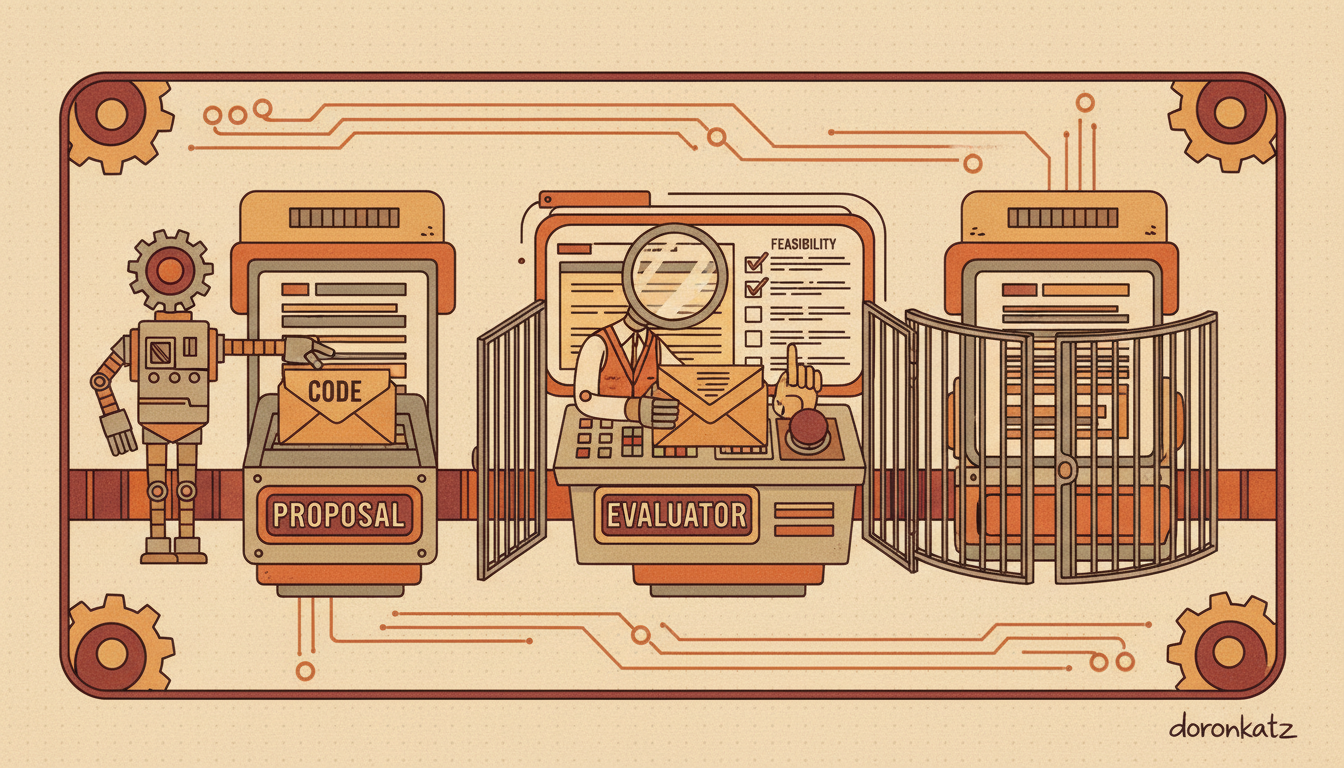
A coding agent can draft a pull request faster than a senior engineer can review the title. That is the entire problem. We are now living through the phase where implementation becomes abundant and the bottleneck moves upstream, into the part of the system that decides whether the proposed change is admissible. The agent proposes. The pipeline disposes. TPMs own the contract between the two.
This is not another "tests are steering wheels" piece. Tests steer the agent during implementation. The release contract is what evaluates the finished proposal and decides whether it may advance. The new control surface for TPMs is not the agent harness. It is the pipeline gate.
The shift that made this urgent
Four signals landed on August 12–13 and pushed this from a theoretical concern into an operating problem.
DevOps.com framed the agent-proposes/pipeline-disposes pattern. Bounded-write agents, protected paths, change-budget gates, policy as code, independent evaluations, and provenance attestations are the controls for AI-authored change. The framing is explicit: the pipeline becomes the governance boundary, not just the automation lane.
A practitioner X thread on Spotify's agent development environment surfaced the gap between visibility and trust. An impressive demo is not the same thing as an engineering workflow that production teams will adopt. Product visibility is outrunning operational proof.
OpenAI Codex shipped `rust-v0.148.0-alpha.12` at 06:43 UTC after `alpha.11` at 04:11 UTC. Two alpha runtime releases inside three hours. Whatever release contract you wrote last quarter is now reviewing changes produced by a different runtime than the one that shipped the original contract.
A high-engagement Hacker News essay argued that AI is removing the middle layer of software engineering. The story reached 1,014 points and 937 comments on Hacker News — a load-bearing engagement signal that the role shift itself has become a top-of-mind practitioner concern. The remaining team has more coordination and judgment per change, not less.
Together, these signals point to a release-control shift: as implementation becomes abundant, the pipeline becomes the accountable decision-maker.
What the agent owns, and what it does not
Let us be precise. A coding agent that proposes changes owns the proposal. It drafts the diff, runs its own tests where appropriate, opens the pull request, and writes the description. It does not own the promotion decision. The promotion decision belongs to a system that was not generated by the same prompt.
The risk in letting the agent own both is structural. The agent that wrote the code is also evaluating the code. The test fixtures are arguably generated by the same prompt. The policy configuration might have been bootstrapped from the agent's own first run. Even a sophisticated harness collapses author, reviewer, and release authority into one opaque loop. The pipeline that wants to remain independent has to treat every agent-authored artifact as an untrusted proposal and re-derive its evidence from sources the agent did not author.
This is the TPM's seat. The pipeline contract is not a developer-experience project. It is a release-governance artifact, and TPMs are the ones who carry the cross-functional coordination between security, platform, and product.
The release contract
A workable release contract has six parts. Each part is owned by a name, not a wiki page.
1. The agent-to-pipeline contract. The agent may propose changes. Only the pipeline may authorize promotion to the next environment. This is documented in the launch PRD with a line that names the boundary, not a single diagram that nobody re-reads.
2. Risk classification by surface. Repositories, files, and operations are classified by risk so protected paths, production configuration, migrations, and credential changes receive stricter evidence requirements. A marketing-page copy edit and a database migration are not the same change class.
3. Independent checks for generated changes. Tests, static analysis, security scans, provenance attestations, and a reviewer who did not author the proposal. Independence is the load-bearing word. If the agent helped generate the test fixtures, the test suite is no longer independent. The TPM's job is to keep one reviewer and one toolset that the agent did not touch.
4. Change budgets per run. Files, lines, dependencies, environments, side effects. The proposal fails closed when it exceeds its budget. A refactor that touches 200 files is a different change than a refactor that touches 20, and the pipeline needs to know which one is in front of it.
5. Versioned delivery system. The model, agent runtime, harness, prompts, policy bundle, and test corpus are versioned together. A regression can then be attributed to the full delivery system, not the model alone. "It worked in staging" stops being a useful phrase when the staging runtime, the production runtime, and the harness differ.
6. Measurement that does not reward throughput. Escaped defects, rollback rate, review effort, evidence completeness, and time-to-recovery are tracked separately from agent throughput or pull-request count. The fastest agent is rarely the safest one, and a metric that praises PRs-per-day is a metric that has already lost.
The five artifacts that make the contract real
Documentation is not the contract. The contract is the five artifacts a TPM writes before the agent gets write access to a production repository.
A risk matrix per repository. Which paths are protected? Which paths require two reviewers? Which paths require a security review in addition to a code review? This is not a global rule. It is a per-repository matrix that the platform team and the security team co-own.
A change-budget table. Files per run, lines per run, dependencies introduced per run, environments touched per run. Each run is bounded; exceeding the bound fails the run. The numbers are conservative at first and loosened only with evidence.
An evidence packet schema. Every promotion produces the same artifact: the diff, the test results, the static analysis output, the security scan output, the provenance attestation, and the reviewer identity. The packet is the single object the pipeline inspects. It is not a Slack thread.
A reviewer-independence rule. The reviewer did not author the proposal, did not generate the test fixtures, did not write the policy, and did not configure the harness. The rule is in the PRD. It is a checklist item in the PR template.
A kill-switch contract. Who pulls the kill-switch, what triggers the pull, and how long the reversal takes. The answer is in minutes, not hours, and it is owned by a named engineer or named TPM. "The team" does not own a kill-switch.
Worked example: the migration that did not get the contract
A team adopts a coding agent to write data migrations. The agent drafts a migration script that touches 47 tables, renames 12 columns, and rewrites three stored procedures. The diff is 4,800 lines. The agent opens the PR. The CI runs the agent's own tests, all green. The human reviewer approves in seven minutes because the agent wrote a confident description. The migration ships to production.
Three days later, the rollback is a 14-hour incident. Two of the renamed columns were referenced by downstream jobs the agent did not have permission to read. The tests the agent wrote did not cover the downstream jobs because the agent had not been told they existed. The human reviewer approved because the diff looked plausible and the PR description was detailed.
This is a contract failure, not an agent failure. The agent did what it was told. The pipeline did not enforce a change budget, did not require a downstream-systems evidence packet, did not classify the migration as a protected-path operation, and did not give the human reviewer enough time to spot the gap. The contract that would have caught it is small: classify migrations as a protected-path change class, require a dependency map in the evidence packet, and fail closed on any change that touches more than N tables.
The fix is not "use a better agent." The fix is "write the contract that tells the agent and the reviewer what counts as admissible."
What the agent can propose without changing the contract
Most AI-authored change is not a database migration. It is a typo fix, a test addition, a comment clarification, a small refactor inside a non-protected path. The release contract should let these flow without friction. The point is not to slow the agent down. The point is to keep the agent out of the promotion decision.
A useful pattern is the three-lane pipeline.
Green lane. Tests pass, evidence packet complete, change budget under threshold, reviewer-independence confirmed. Auto-promote to the next environment.
Yellow lane. Tests pass, evidence packet complete, but the change budget is exceeded or the reviewer-independence rule could not be confirmed. Hold for human review before promotion.
Red lane. Tests fail, evidence packet incomplete, protected path touched without explicit override, reviewer-independence violated. Fail closed, return to the agent or the human author.
This pattern does not punish the agent. It lets the agent propose freely. It just makes the promotion decision a function of independent evidence, not of agent confidence.
What this does not solve
The release contract does not solve alignment, adversarial prompting, or systemic bias. Those need separate risk controls. NIST AI RMF 1.0 has a wider governance layer that covers them. The release contract also does not solve the upstream question of whether the agent was given a good prompt, an accurate spec, and a well-scoped task. That is the human-in-the-loop-before-the-proposal step, and it is a different problem.
What the release contract does solve is the day-to-day problem of letting an agent produce code without an independent system deciding whether the code is allowed to advance. Without the contract, you find out about reliability problems in the customer escalation queue.
Adoption checklist
- [ ] Write the six-part release contract into the launch PRD before the agent gets write access to production repositories.
- [ ] Name the per-repository risk matrix and the change-budget table. Defaults belong in the contract; per-repository overrides are documented.
- [ ] Configure the evidence packet schema. The packet is the only object the pipeline inspects for promotion.
- [ ] Stamp the reviewer-independence rule into the PR template as a checklist item.
- [ ] Name the kill-switch owner, trigger, and reversal-time target.
- [ ] Schedule the first regression-attribution review at the end of month one. The question is: when a regression happened, how long did it take to attribute it to a specific model, runtime, harness, or prompt change?
The release contract is the artifact that lets the agent be useful without letting it be authoritative. Adopt it before the agent proposes its first protected-path change.
Sources: DevOps.com, "The Agent Proposes, the Pipeline Disposes: Controls for AI-Authored Change" (August 13, 2026); OpenAI Codex release notes, `rust-v0.148.0-alpha.12` (August 13, 2026); Nous Research Hermes Agent release notes, `v2026.8.3` (August 3, 2026); Hacker News, "AI is removing the middle class of software engineering?" — 1,014 points, 937 comments (August 13, 2026); practitioner X thread on Spotify's agent development environment (August 12, 2026).
Send me your release-contract examples, the green/yellow/red lane thresholds you actually ship, and the reviewer-independence rule your platform team enforces. DM me on LinkedIn (Doron Katz). I am collecting working patterns into a public release-governance playbook; ten examples would let me ship it next month.
Member discussion